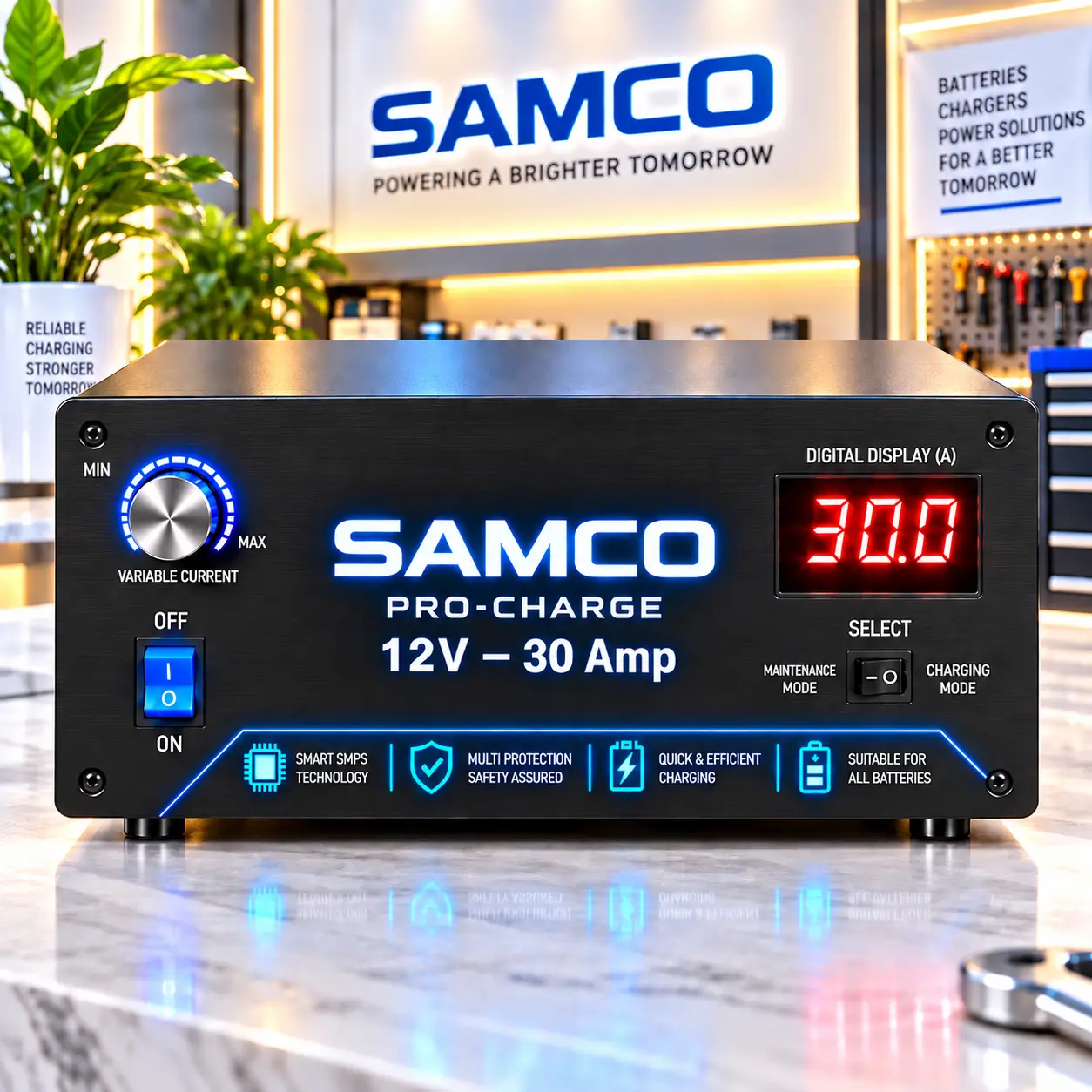
12V 30 Amp Battery Charger — Automatic, 6-Step Knob
The automatic boost charger for big inverter batteries. Six strength steps up to 30 amps, live amps on a digital meter.
The Samco Battery 12V 30 amp battery charger gives 200–300Ah tubular inverter, solar and parallel 12V banks the high charging current that smaller chargers simply don’t have. Turn the six-step knob to the strength you want and watch the amps live on the digital meter.
₹ 9,870Incl. GST · Free shipping · No hidden charges
🏷️ Dealer & bulk discount — WhatsApp for trade price
1–3 days Delhi & Delhi NCR · 3–7 days across India · COD & UPI · 3-day returns
⚡ Quick answer: what is the Samco Battery 12V 30 amp battery charger?
The Samco Battery SB-12-30DG is a fully automatic 12V 30 amp battery charger. The six-step knob (Minimum → Maximum, no amp markings) sets the available charging-current level; the charger regulates the output, and the actual current — which varies with the battery’s condition — shows live on the digital ammeter. Two modes — Charging (Boost) and Maintenance (Float) for standby keeping. Built for 12V lead-acid banks of 200–300Ah: tubular inverter, flat-plate, SMF/VRLA and solar storage.
01Price
12V 30 amp battery charger price in India
The Samco Battery 12V 30 amp battery charger costs ₹9,870 including GST — one price, delivery included. COD and UPI accepted. Battery shops, auto electricians and solar installers get dealer pricing on request.
02Specification
Samco Battery 12V 30 amp automatic battery charger — full specifications
| Output | 12V DC, up to 30A maximum |
|---|---|
| Current control | Six-step knob, Minimum → Maximum — sets the available charging-current level; the charger regulates the output (steps are not marked in amps) |
| Charging modes | Charging (Boost) · Maintenance (Float) |
| Automatic regulation | Yes — the actual current varies with battery voltage, state of charge and condition, and is shown live on the digital ammeter |
| Display | Digital ammeter — live charging current in amps |
| Technology | High-frequency SMPS — efficient, cool-running, light cabinet |
| Primary recommended range | 200–300Ah (and larger 12V parallel banks) — 12V tubular, inverter and solar |
| Lower-capacity use | Possible only where the battery manufacturer’s permitted charging current can be respected on the lower knob steps — see the battery match table |
| Battery types | 12V lead-acid — tubular, flat plate, SMF, VRLA and AGM. GEL only with GEL-specific charging-voltage configuration — confirm with Samco Battery at order. Not for lithium-ion or LiFePO₄ |
| Bank configuration | Single 12V batteries and 12V parallel banks only — not 24V, 36V or 48V series banks (24V range here) |
| Protection | Overload, short circuit and reverse polarity |
| Warranty & returns | 6 months against manufacturing defects · 3-day return window on unopened goods (return shipping paid by customer) — full terms |
| Price & delivery | ₹9,870 including GST · free delivery · 1–3 days Delhi & Delhi NCR, 3–7 days all over India |
| Made by | Samco Battery (Samco Rubber & Batteries), Delhi — est. 2000 · SKU SB-12-30DG |
03Why 30 amps
Why buy a 30 amp boost charger instead of a 10A or 15A?
A 30 amp charger exists for one reason: big batteries charge slowly on small chargers. On the industry guideline of roughly 10% of rated capacity, a 300Ah tubular battery wants about 30 amps — a 10A charger on the same bank can take well over a day. This is the charger Indian battery shops call a boost charger: high current in, a full battery out.
Roughly triple the current of a 10A unit
Where a 10A charger grinds on for a day or more, the 30A delivers about three times the current — the same bank recovers in a fraction of the time. Actual duration depends on state of charge, battery condition and temperature.
One charger, every battery on the bench
Turn the knob to a strength — the charger regulates the output while the battery takes what its condition allows, easing off as it fills. One unit covers the whole shop range.
See the charge happening
High amps into an empty battery, a falling reading as it fills. The meter shows the actual current at all times — you never have to guess.
04Fast charging
When to turn the knob up — fast charging, sulphation & acid stratification
Fast (Boost) charging means a higher charging current — used when the battery manufacturer’s specifications permit it. A deeply discharged battery often needs that firmer start to accept a charge at all. Higher current is not a repair, though: a deeply discharged or sulphated battery may still require testing or a dedicated regeneration/desulfation process.
Weak & sulphated batteries
Batteries left discharged for months build sulphate on the plates. A higher charging current may help a mildly sulphated battery accept a charge again — but recovery is never guaranteed. Batteries that won’t respond need testing, or the dedicated 12V 15A regeneration charger.
Deeply discharged batteries
A battery drained to near zero may draw hard on a higher step — the firm start it needs to begin recovering, with the charger regulating the flow. No draw at all, or a battery that gets hot? Stop and have it tested.
Mixing the electrolyte
In a flooded battery, acid is heavier than water and settles at the bottom while water sits on top — “acid stratification” — leaving lower plates in strong acid and upper plates in weak. A stronger charge gasses the electrolyte and stirs the two back together. Always stay within the battery maker’s specified charging current when you do.
05Battery match
Which batteries can this 30 amp charger charge?
It is built for 12V lead-acid batteries of 200–300Ah — larger 12V parallel banks included. Smaller batteries can be charged on the lower knob steps only where the battery manufacturer’s permitted charging current can be respected. Match your use case below:
| Use case (India) | Battery type | Capacity | Tier |
|---|---|---|---|
| Large home & shop inverter banks | 12V tubular | 200Ah – 300Ah+ | Primary |
| Commercial backup — clinics, schools, showrooms | 12V tubular / flat plate | 200Ah+ | Primary |
| Solar storage — off-grid homes & farms | 12V tubular / VRLA | 200Ah+ | Primary |
| Deep-cycle & traction — scrubbers, golf carts | 12V deep cycle | 200Ah+ | Primary |
| E-rickshaw cells, charged one at a time | 12V lead-acid | 100Ah – 150Ah | Lower knob steps* |
| Tractor, harvester & pump-set batteries | 12V flooded | 80Ah – 180Ah | Lower knob steps* |
| Genset / DG set starter batteries | 12V SMF | 65Ah – 150Ah | Lower knob steps* |
What it fits
- Single 12V lead-acid batteries — tubular, flat plate, SMF, VRLA, AGM
- 12V banks wired in parallel (parallel stays at 12V)
- Large tubular inverter & solar storage banks, 200Ah+
- Deep-cycle and traction batteries on a suitable step
- Individual 12V cells pulled from e-rickshaw packs
What it’s not for
- 24V, 36V or 48V series banks — see the 24V charger range instead
- A complete 48V/60V e-rickshaw pack charged as one bank
- Lithium-ion and LiFePO₄ batteries — never
- GEL batteries, unless you’ve confirmed the maker’s charging voltage with us
- Bike, scooter and small sealed batteries — see the bike battery charger or the 12V 10A charger
06Wiring
Series or parallel? Check this before you connect
Parallel banks charge here; series banks don’t. Two 12V batteries wired in series make a 24V bank — that needs a 24V charger, though you can disconnect and charge them one at a time on this unit. Two 12V batteries in parallel stay at 12V and double the Ah, so a bank of two 200Ah batteries charges together here on a suitable knob step. Getting this wrong is the single most common mistake on big banks — trace your wiring first.
07In use
How to charge — 3 steps with the six-step knob
Set mode & strength
Charging (Boost) mode for a flat battery. Lower knob step for smaller batteries, higher step for 200Ah+ banks — always within the battery maker’s specified current.
Connect, then switch on
Red clamp to positive (+), black to negative (–), charger switched off. Then switch on — the ammeter jumps as the battery draws current.
Watch the amps taper
The reading falls as the battery fills. When charged, switch to Maintenance (Float) for standby keeping — or switch off mains before removing clamps.
08Applications
Who uses a 12V 30 amp battery charger in India
Large tubular inverter banks
200–300Ah home and shop batteries where a 10A charger runs all day. For 100–180Ah banks, the 12V 15A SMPS charger is the cheaper fit.
12V solar storage banks
Off-grid storage topped from mains after low-sun days or long power cuts. Parallel 12V banks supported; series 24V banks are not.
Battery shops & service bays
Bench charging where big batteries come through daily and turnaround sells. The knob steps down for smaller stock, so a single machine serves the whole counter.
DG sets & industrial 12V banks
Generator and industrial standby batteries that must come back fast after a deep discharge — hospitals, hotels, factories, petrol pumps. Float mode is intended to hold them ready between cuts, within the battery maker’s float-charging guidance. For heavier industrial duty, see the industrial battery charger range.
Tractor, truck & earthmover batteries
Heavy 12V starters in farm and construction equipment. For 24V truck systems, see the 24V truck battery charger; for 24V pairs in series, use the dual-voltage 12V/24V range.
Under 200Ah?
The 12V 20A FCBC or the 12V 10A variable charger match smaller banks more closely — and cost less.
09Delhi & NCR
Buy your battery charger in Delhi & Delhi NCR — pickup or doorstep
Samco Battery (Samco Rubber & Batteries) builds and ships from 21 Gokhale Market, Kashmere Gate — the heart of Delhi’s battery and power-equipment trade, minutes from Kashmere Gate Metro. Walk in during shop hours to see the charger running, or order on WhatsApp and we’ll courier it to your door — to every locality in Delhi, to every city in Delhi NCR, and to every pincode we serve across India.
Every locality in Delhi and every Delhi NCR city is typically covered in 1–3 working days; the rest of India takes 3–7 working days. Shipping is free on both.
10Questions
12V 30 amp automatic battery charger — FAQs
What does the six-step knob do?
The six-step knob sets the available charging-current level. The charger regulates the output, while the actual charging current varies with battery voltage, state of charge and condition and is shown on the digital ammeter.
What size battery is a 30 amp charger best for?
12V batteries from 200Ah up — tubular inverter banks, solar storage, large parallel banks. That is the charger’s primary fit. Smaller batteries can be charged on the lower steps only where the battery manufacturer’s permitted charging current can be respected.
What is a boost charger?
The shop-floor name for a charger with enough current to rescue a big battery in one session instead of a slow overnight trickle. This unit is exactly that — and it’s automatic: you set the strength, it manages the current through to the taper.
When should I use fast charging?
When the battery manufacturer’s specifications permit a higher charging current — typically to bring a deeply discharged bank back, or to stir a flooded battery’s electrolyte against acid stratification. Higher current is not a repair: a sulphated or degraded battery may still need testing or a dedicated regeneration/desulfation charger.
Is 30 amps too high for a 100Ah or 150Ah battery?
30A is the charger’s maximum output, not the current every battery will receive. For a 100Ah or 150Ah battery, start at a low knob setting and adjust while monitoring the ammeter. Keep the charging current within the battery manufacturer’s specified limit.
Kya 30 amp charger se 200Ah–220Ah tubular inverter battery charge ho jaayegi?
Haan — bilkul. 200Ah se 220Ah tak ki tubular inverter battery isi charger ki primary range mein aati hai. Charger automatic hai: khaali battery zyada current kheenchti hai, full hone par apne aap kam — actual amps live digital meter par dikhte hain. Time ka aasaan formula: replace hone wale amp-hours ÷ average charging current, phir taper stage ke liye thoda extra. Misal: aadhi discharge 200Ah battery mein lagbhag 100Ah bharna hota hai — average ~20A par lagbhag 5 ghante, taper ke baad thoda aur. Asli time battery ki condition, state of charge, temperature aur manufacturer ki charging specification par depend karta hai.
Can I charge two 12V batteries connected in series?
Not while they’re joined in series — that’s a 24V bank for a 24V charger. Unhook them and charge one at a time on this unit instead. Wired in parallel they stay at 12V and pool their amp-hours, so both charge together here.
Which batteries are compatible with the Samco Battery 12V 30 amp charger?
Every 12V lead-acid type — tubular, flat-plate, sealed SMF, VRLA and AGM — within the maker’s charging specs. Check with us before connecting GEL, which usually wants a lower charging voltage. Never 24V/36V/48V banks; never lithium-ion or LiFePO₄.
Is it good for 12V solar battery banks?
Yes — 12V storage banks of 200Ah and up, single or parallel-wired. After a stretch of poor sun, plug in from the mains and let the automatic charge bring the bank back. It’s a mains charger that works alongside your solar, not an MPPT controller.
How long does it take to charge a 200Ah battery?
Amp-hours to replace, divided by the average current shown on the ammeter, plus extra time for the taper stage. Example: a half-discharged 200Ah battery has around 100Ah to replace — at an average 20A that’s roughly 5 hours before the taper, so plan a little longer. Actual time varies with battery condition, state of charge, temperature and the battery maker’s charging specifications.
Can I leave it connected all the time?
Only under the right conditions. Float mode is intended for standby maintenance, but continuous connection is appropriate only when the charger’s float voltage is suitable for the particular battery and the battery manufacturer’s instructions permit continuous float charging. When in doubt, check with the battery maker — or with us — before leaving a battery on float unattended.
What’s the price, and do you ship all over India?
₹9,870 including GST, delivered free wherever we ship. WhatsApp or call 99539 35912 to order — COD, UPI and trade pricing available.
How fast is delivery in Delhi and Delhi NCR?
1–3 working days for Delhi and every NCR city, 3–7 for the rest of India — shipping free either way. Dispatch is from our Kashmere Gate shop, where pickup is welcome 11 AM – 5 PM, Mon–Sat.
What warranty and returns apply?
Six months on manufacturing faults. Unopened units can come back within 3 days of delivery — return postage is yours. The full policy lives on our warranty & returns page.
Do you offer dealer or bulk pricing?
Yes — WhatsApp or call 99539 35912 with your quantity for same-day trade rates, whether you run one bench or a fleet.
11Compare
Compare all Samco Battery 12V chargers
| Model | Output | Best for | Price |
|---|---|---|---|
| 12V 10A variable | 0–10A | 7–220Ah · bikes to home inverters | ₹3,234 |
| 12V 15A SMPS | 0–15A | 100–180Ah tubular & solar banks | ₹4,206 |
| 12V 20A FCBC | Boost + Float | 100–220Ah inverter banks with float maintenance | ₹7,782 |
| 12V 30A digital (this page) | 6-step · up to 30A · Boost + Float | 200–300Ah+ · automatic · shops & big banks | ₹9,870 |
Full 12V range on the 12 volt battery charger page. Need 24V? Browse the 24 volt battery charger range, including the 24V 30A digital charger. Handling both 12V and 24V banks? See the dual-voltage 12V/24V chargers. For severely sulphated stock that won’t recover even on fast charge, dedicated regeneration is a different job — the 12V 15A regeneration charger.
Order your Samco Battery 30 amp charger today — ₹9,870
Made in Delhi by Samco Battery (Samco Rubber & Batteries) — charging Indian batteries since 2000. One charger or a trade order, WhatsApp is the fastest way to a quote.
3-day returns on unopened goods · return shipping paid by customer
Samco Battery (Samco Rubber & Batteries) — designing and manufacturing SMPS battery chargers and charging equipment in Delhi since 2000. Serving Delhi and Delhi NCR with nationwide delivery across India.
21 Gokhale Market, Near Kashmere Gate Metro Station, Delhi – 110054, India
Phone / WhatsApp: 99539 35912 · Shop hours 11:00 AM – 5:00 PM, Monday to Saturday
Google Business Profile